Dates - Yellow Fresh
Country of Origin - Iraq
Average Weight - 15 Grams
Introduction
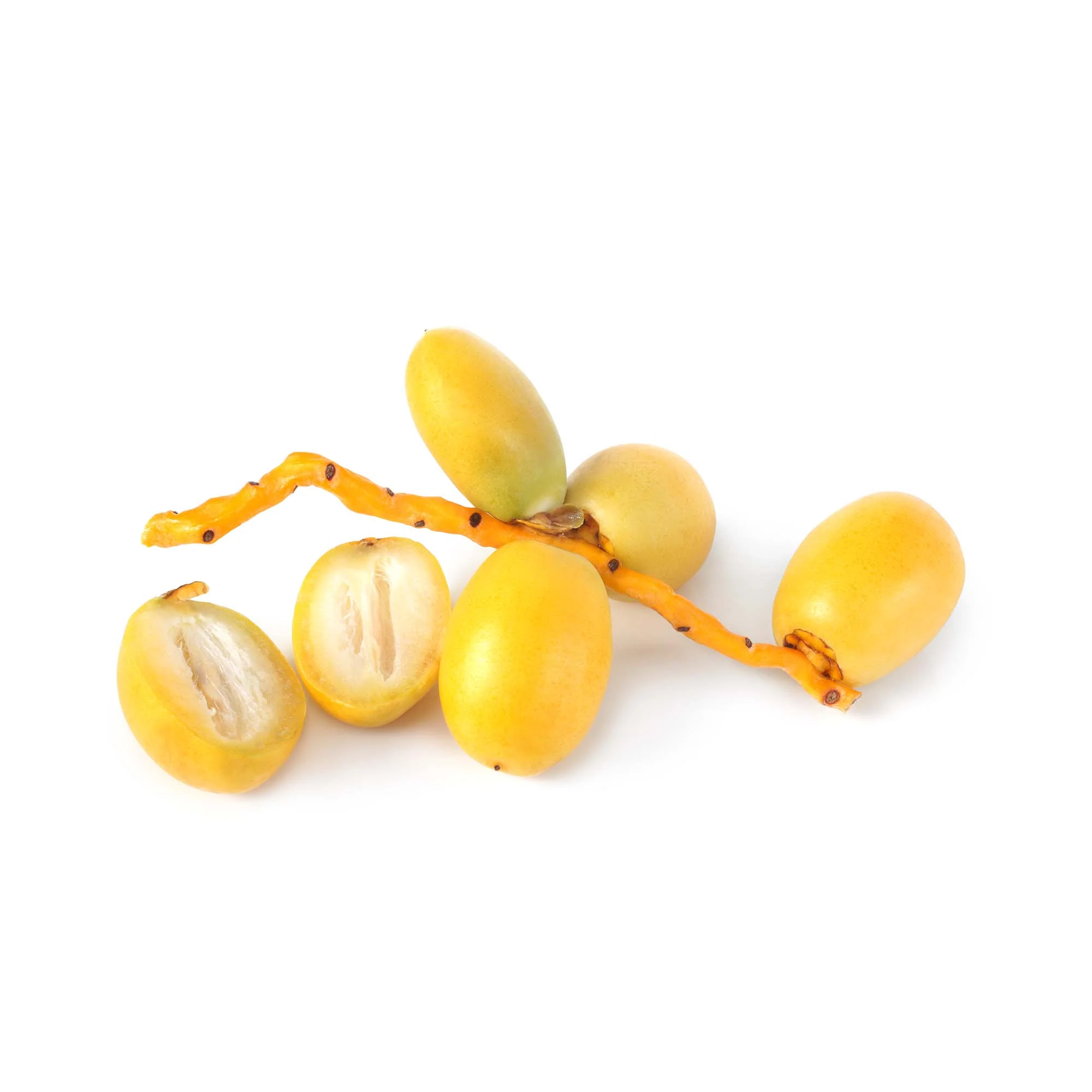
Fresh Yellow Dates are also known as Yellow Barhi Dates, Phoenix Dates, and Khalal Barhi Dates. They are very unique and rare and can usually only be found in fresh markets in hot, dry countries throughout the summer. When fresh, they have a firm, crisp, yellow flesh and a crunchy texture. When riper, they become dried, sticky, and creamy. Yellow Dates can be enjoyed at all stages of ripeness. They contain a small brown stone - or pit - that is inedible.
History
Yellow Barhi Dates have been cultivated for centuries as a sweet, nutritional food source. They are thought to be native to Iraq and were spread across to other warm countries in Asia, North Africa, and the Middle East via trade routes. Yellow Dates reached the USA in 1913 and soon became very popular for their astringent, sweet flavour. They are historically used as an ingredient during the Jewish New Year celebrations. Families are known to enjoy symbolic meals to honour the holiday, and that includes fresh Yellow Dates alongside other dates, figs, and grapes – delicious!
Regions
Yellow Dates originated in Iraq, but are now grown and distributed all over the world in the Middle East, Africa, India, Southeast Asia, Mexico, and the USA.
Flavours & Texture
Fresh Yellow Dates have a firm, crisp, fibrous flesh that becomes soft, chewy and sticky when ripened at room temperature. The flavour is sweet, mild, and slightly astringent. The flavour of Yellow Dates varies slightly depending on ripeness, but can often have notes of coconut, butterscotch, or cinnamon.
Preparation
Yellow Dates can be eaten fresh and raw as a delicious, sweet, healthy snack – just ensure you don't eat the seed/pit in the middle. They are also known to be used in a variety of sweet and savoury dishes.
Nutritional Value
Yellow Dates are a great source of fibre, potassium, copper, and manganese.
|
Calories per 100 g |
107 Kcal |
|
Fat |
0.1 g |
|
Carbohydrates |
27 g |
|
Fibre |
3 g |
|
Protein |
1.3 g |
Country of Origin - Iraq
Average Weight - 15 Grams
Introduction
Fresh Yellow Dates are also known as Yellow Barhi Dates, Phoenix Dates, and Khalal Barhi Dates. They are very unique and rare and can usually only be found in fresh markets in hot, dry countries throughout the summer. When fresh, they have a firm, crisp, yellow flesh and a crunchy texture. When riper, they become dried, sticky, and creamy. Yellow Dates can be enjoyed at all stages of ripeness. They contain a small brown stone - or pit - that is inedible.
History
Yellow Barhi Dates have been cultivated for centuries as a sweet, nutritional food source. They are thought to be native to Iraq and were spread across to other warm countries in Asia, North Africa, and the Middle East via trade routes. Yellow Dates reached the USA in 1913 and soon became very popular for their astringent, sweet flavour. They are historically used as an ingredient during the Jewish New Year celebrations. Families are known to enjoy symbolic meals to honour the holiday, and that includes fresh Yellow Dates alongside other dates, figs, and grapes – delicious!
Regions
Yellow Dates originated in Iraq, but are now grown and distributed all over the world in the Middle East, Africa, India, Southeast Asia, Mexico, and the USA.
Flavours & Texture
Fresh Yellow Dates have a firm, crisp, fibrous flesh that becomes soft, chewy and sticky when ripened at room temperature. The flavour is sweet, mild, and slightly astringent. The flavour of Yellow Dates varies slightly depending on ripeness, but can often have notes of coconut, butterscotch, or cinnamon.
Preparation
Yellow Dates can be eaten fresh and raw as a delicious, sweet, healthy snack – just ensure you don't eat the seed/pit in the middle. They are also known to be used in a variety of sweet and savoury dishes.
Nutritional Value
Yellow Dates are a great source of fibre, potassium, copper, and manganese.
|
Calories per 100 g |
107 Kcal |
|
Fat |
0.1 g |
|
Carbohydrates |
27 g |
|
Fibre |
3 g |
|
Protein |
1.3 g |
Description
Country of Origin - Iraq
Average Weight - 15 Grams
Introduction
Fresh Yellow Dates are also known as Yellow Barhi Dates, Phoenix Dates, and Khalal Barhi Dates. They are very unique and rare and can usually only be found in fresh markets in hot, dry countries throughout the summer. When fresh, they have a firm, crisp, yellow flesh and a crunchy texture. When riper, they become dried, sticky, and creamy. Yellow Dates can be enjoyed at all stages of ripeness. They contain a small brown stone - or pit - that is inedible.
History
Yellow Barhi Dates have been cultivated for centuries as a sweet, nutritional food source. They are thought to be native to Iraq and were spread across to other warm countries in Asia, North Africa, and the Middle East via trade routes. Yellow Dates reached the USA in 1913 and soon became very popular for their astringent, sweet flavour. They are historically used as an ingredient during the Jewish New Year celebrations. Families are known to enjoy symbolic meals to honour the holiday, and that includes fresh Yellow Dates alongside other dates, figs, and grapes – delicious!
Regions
Yellow Dates originated in Iraq, but are now grown and distributed all over the world in the Middle East, Africa, India, Southeast Asia, Mexico, and the USA.
Flavours & Texture
Fresh Yellow Dates have a firm, crisp, fibrous flesh that becomes soft, chewy and sticky when ripened at room temperature. The flavour is sweet, mild, and slightly astringent. The flavour of Yellow Dates varies slightly depending on ripeness, but can often have notes of coconut, butterscotch, or cinnamon.
Preparation
Yellow Dates can be eaten fresh and raw as a delicious, sweet, healthy snack – just ensure you don't eat the seed/pit in the middle. They are also known to be used in a variety of sweet and savoury dishes.
Nutritional Value
Yellow Dates are a great source of fibre, potassium, copper, and manganese.
|
Calories per 100 g |
107 Kcal |
|
Fat |
0.1 g |
|
Carbohydrates |
27 g |
|
Fibre |
3 g |
|
Protein |
1.3 g |