Banana - Red
Country of Origin: Ecuador 🇪🇨
Average Weight: 143 Grams
Introduction
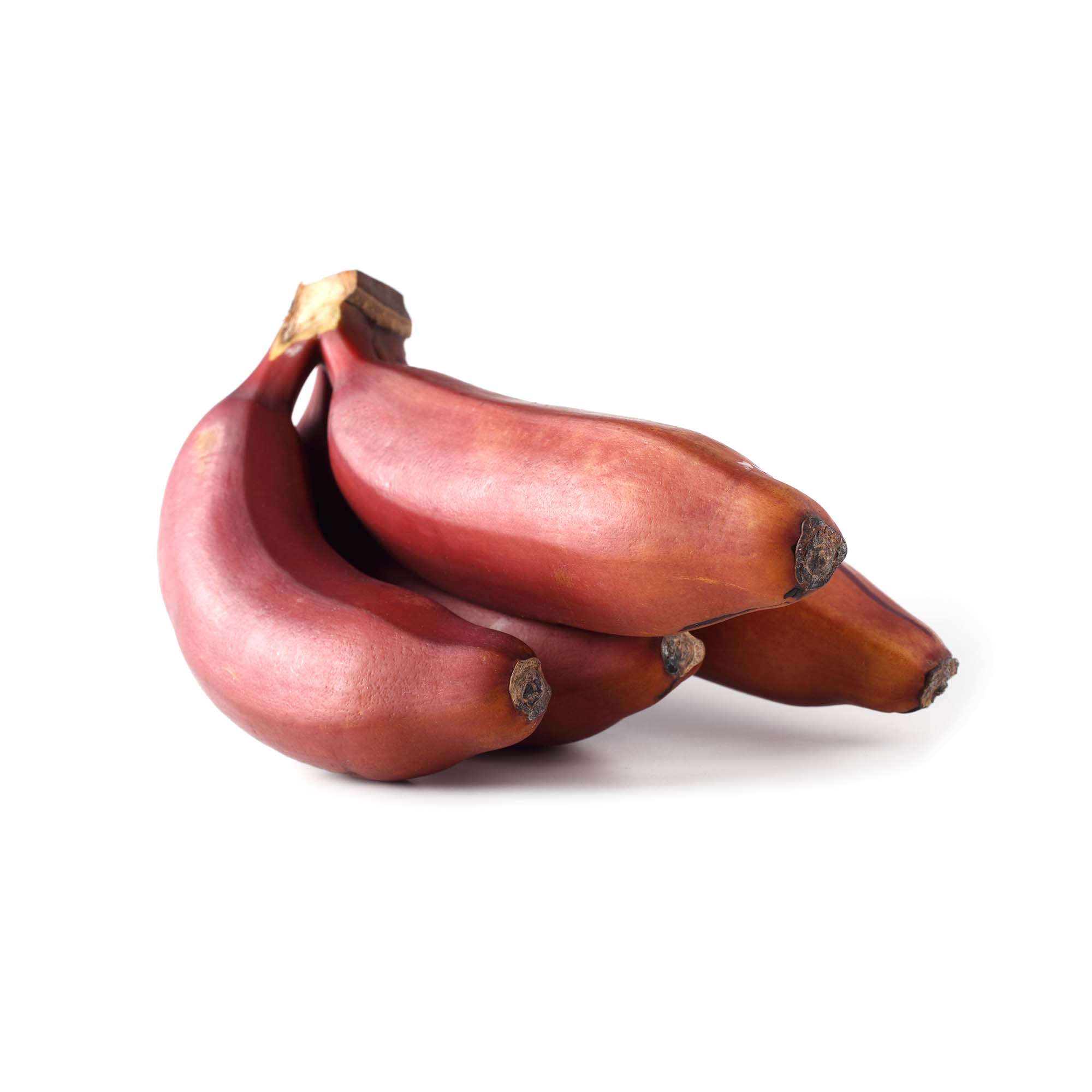
The common cavendish banana is probably jealous of its less-known cousin, the red banana. Why? This variety is softer and sweeter, contains more carotene and vitamin C, and is even considered an aphrodisiac! Plus, when ripe and raw, the flesh is almost light pink which is pretty cool.
History
Sadly, most of the red banana’s history is unknown, but it’s thought that they originated in India and were gradually introduced to banana-growing regions across the world via trade. In the early 1900s, they began being sold in Eastern USA, although rumour has it they were sold in Toronto, Canada as early as the 1870s.
Regions
Red bananas are found in East Africa, Asia, South America, and the UAE, but are thought to have originated in India.
Flavours & Texture
Red bananas are similar to common bananas in taste and texture, but are slightly softer and have a sweeter, almost raspberry-like taste.
Preparation
You can eat red bananas in the same way as regular bananas – by peeling the skin and eating the flesh.
Nutritional Value
Red bananas are rich in carotene and vitamin C, making them great for immunity, digestion, and energy. In India, they are used to promote fertility.
|
Calories per 100 g |
93 |
|
Fat |
0.4 |
|
Carbohydrates |
24 |
|
Fibre |
3 |
|
Protein |
0.7 |
Country of Origin: Ecuador 🇪🇨
Average Weight: 143 Grams
Introduction
The common cavendish banana is probably jealous of its less-known cousin, the red banana. Why? This variety is softer and sweeter, contains more carotene and vitamin C, and is even considered an aphrodisiac! Plus, when ripe and raw, the flesh is almost light pink which is pretty cool.
History
Sadly, most of the red banana’s history is unknown, but it’s thought that they originated in India and were gradually introduced to banana-growing regions across the world via trade. In the early 1900s, they began being sold in Eastern USA, although rumour has it they were sold in Toronto, Canada as early as the 1870s.
Regions
Red bananas are found in East Africa, Asia, South America, and the UAE, but are thought to have originated in India.
Flavours & Texture
Red bananas are similar to common bananas in taste and texture, but are slightly softer and have a sweeter, almost raspberry-like taste.
Preparation
You can eat red bananas in the same way as regular bananas – by peeling the skin and eating the flesh.
Nutritional Value
Red bananas are rich in carotene and vitamin C, making them great for immunity, digestion, and energy. In India, they are used to promote fertility.
|
Calories per 100 g |
93 |
|
Fat |
0.4 |
|
Carbohydrates |
24 |
|
Fibre |
3 |
|
Protein |
0.7 |
Original: $2.04
-65%$2.04
$0.71Description
Country of Origin: Ecuador 🇪🇨
Average Weight: 143 Grams
Introduction
The common cavendish banana is probably jealous of its less-known cousin, the red banana. Why? This variety is softer and sweeter, contains more carotene and vitamin C, and is even considered an aphrodisiac! Plus, when ripe and raw, the flesh is almost light pink which is pretty cool.
History
Sadly, most of the red banana’s history is unknown, but it’s thought that they originated in India and were gradually introduced to banana-growing regions across the world via trade. In the early 1900s, they began being sold in Eastern USA, although rumour has it they were sold in Toronto, Canada as early as the 1870s.
Regions
Red bananas are found in East Africa, Asia, South America, and the UAE, but are thought to have originated in India.
Flavours & Texture
Red bananas are similar to common bananas in taste and texture, but are slightly softer and have a sweeter, almost raspberry-like taste.
Preparation
You can eat red bananas in the same way as regular bananas – by peeling the skin and eating the flesh.
Nutritional Value
Red bananas are rich in carotene and vitamin C, making them great for immunity, digestion, and energy. In India, they are used to promote fertility.
|
Calories per 100 g |
93 |
|
Fat |
0.4 |
|
Carbohydrates |
24 |
|
Fibre |
3 |
|
Protein |
0.7 |